
What If Nursery Fees Are Costing You More Than They Cost Your Employees?
Why the nursery bill has become a retention problem for employers with female workforces.

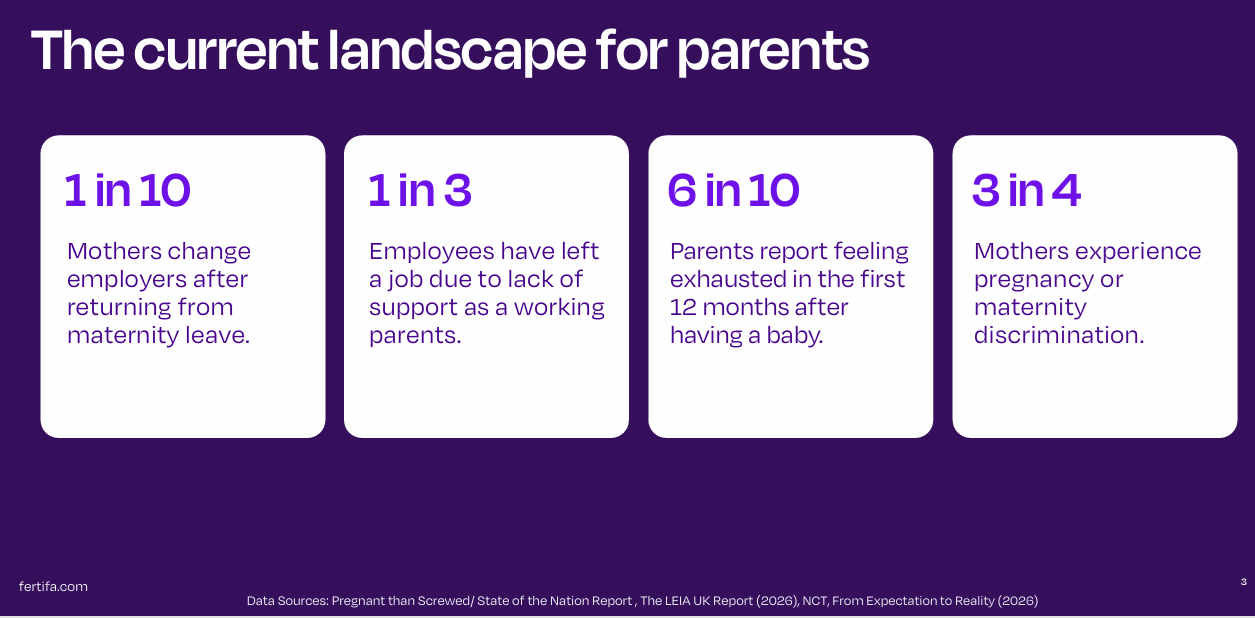
These are not childcare statistics. They are HR nightmares.
If a valued employee handed in her notice tomorrow, you would ask why. Salary? Her manager? Flexible working? A better offer somewhere else?
If she has recently had a child, there may be another number sitting behind the decision, and it is one that you can manage.
The nursery fees.
The research is clear about who absorbs the consequence when a family's childcare calculation stops making sense.
You have already paid to build that experience
Think about the employee you are potentially losing. You recruited her. You trained her. She knows your customers, your systems and your people. She may have spent five, ten or fifteen years building knowledge inside the business that cannot be transferred to a replacement during a two-week handover.
Then she has a baby.
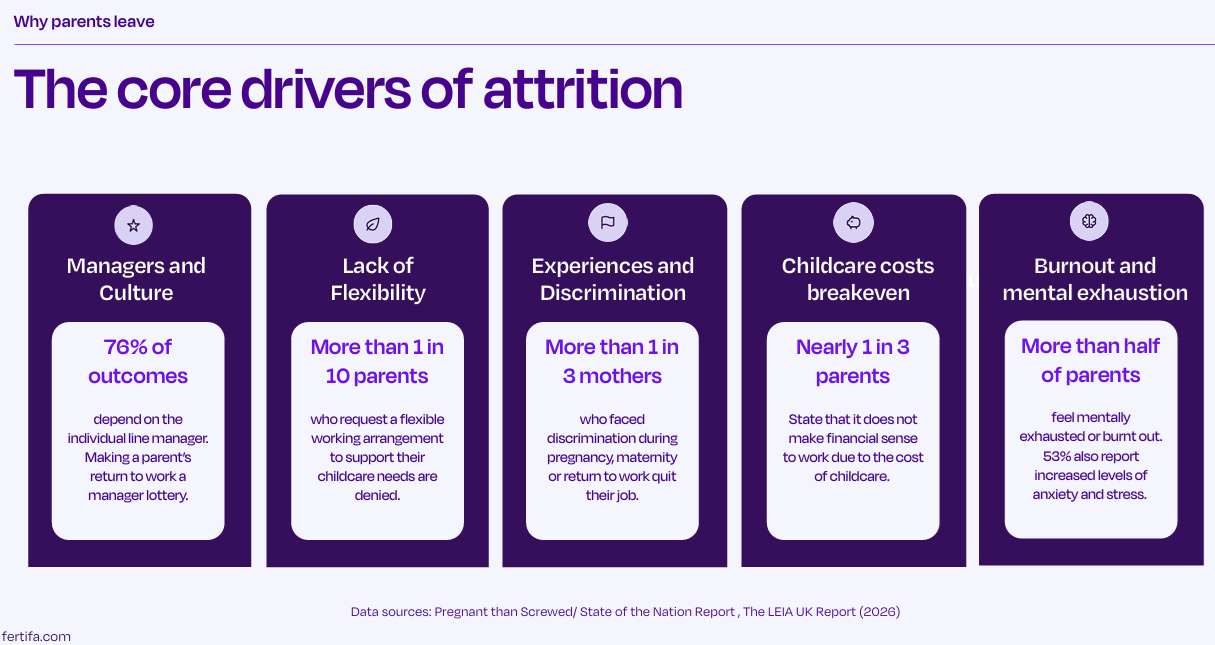
Six in ten parents report feeling exhausted during the first twelve months after having a baby. More than half report feeling mentally exhausted or burnt out. More than one in ten parents who request flexible working to cover their nursery hours have the request refused.
Fertifa's research highlights something particularly uncomfortable for employers: 76% of a parent's experience of returning to work depends on their individual line manager.
Two women can return to the same company, in the same month, on the same terms, and have completely different experiences. Then there is the nursery bill.
The number that can make returning to work feel pointless
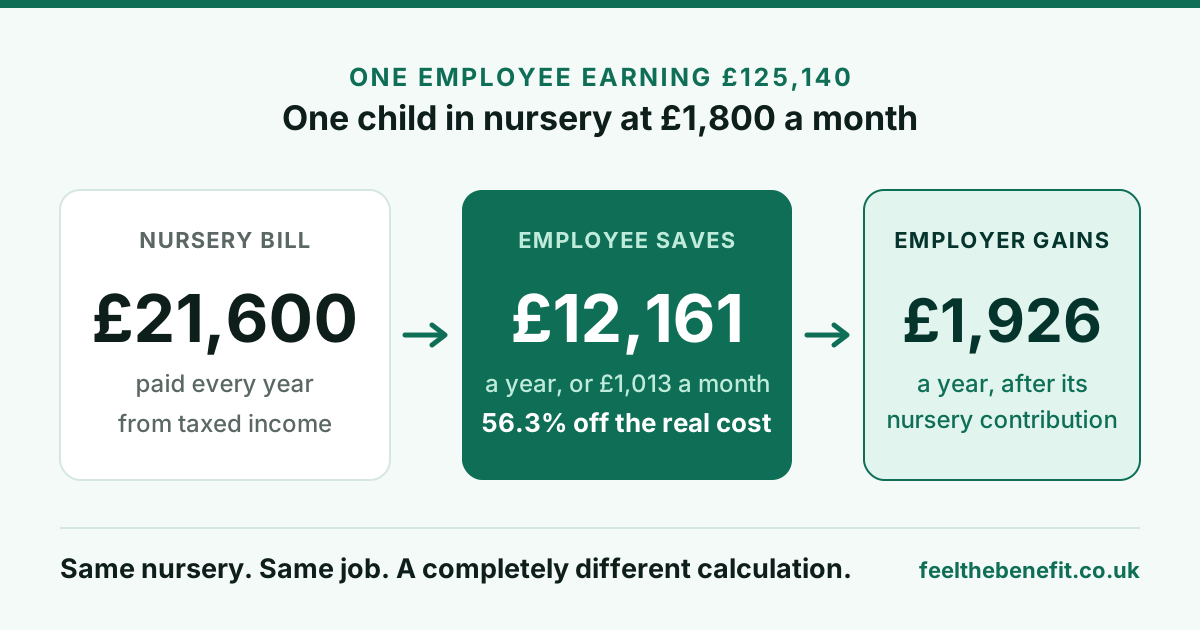
Imagine one of your employees is paying £1,800 a month for a nursery place. That is £21,600 every year.
But she does not earn £21,600 to pay that bill. She has to earn considerably more, because nursery fees are normally paid from salary that has already been through Income Tax and National Insurance.
Earn. Pay tax. Pay National Insurance. Then pay the nursery from whatever is left.
For some parents, that is the moment the calculation stops making sense. They are not saying they do not want to work. They are looking at what actually arrives in their bank account, setting it against nursery fees, commuting and everything else that comes with returning, and asking whether it still adds up.
She does not leave because she stopped caring about her career. She leaves because she can be working full-time but only taking home a few hundred pounds after the nursery fee costs are paid from ther taxed income!
The cost does not disappear when nursery ends
A few years out of work can look temporary. Its effect is not.
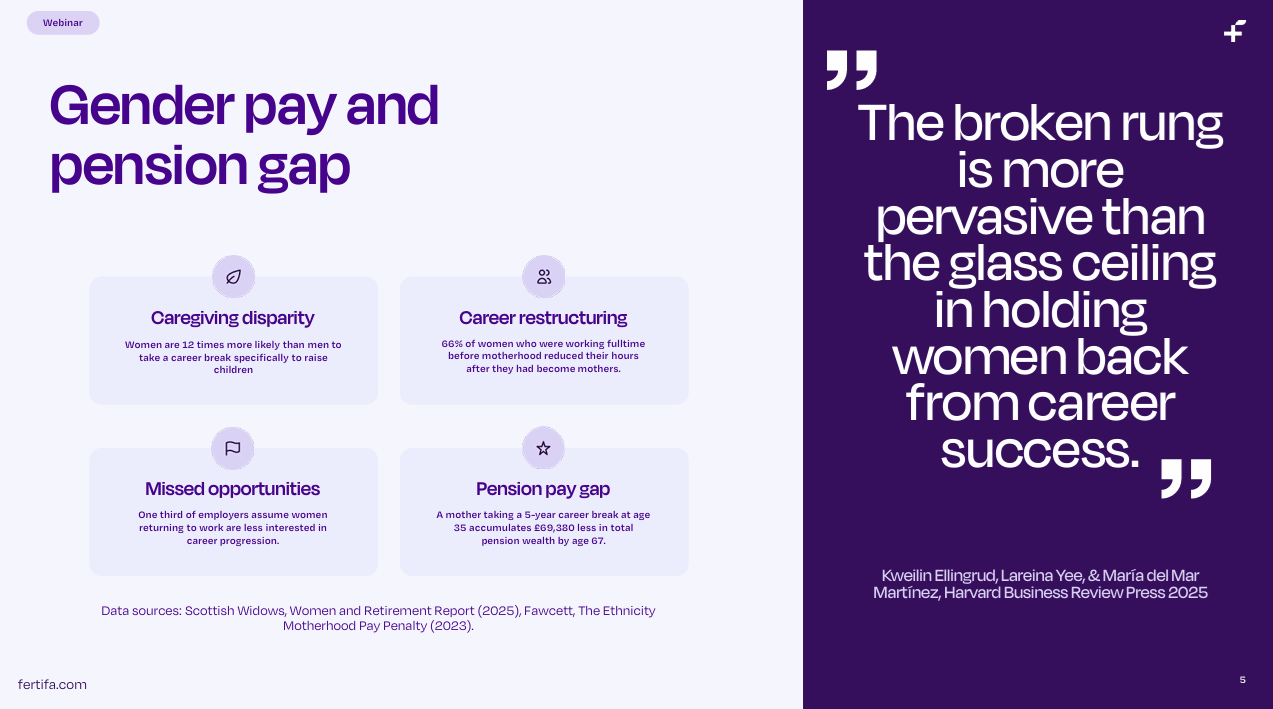
A woman taking a five-year career break at age 35 is estimated to accumulate £69,380 less pension wealth by age 67.
There are also lost promotions, slower salary progression, reduced pension contributions and years of experience that never make it onto the next CV. One third of employers assume that women returning to work are less interested in career progression, which shapes what she is offered next.
This is part of the broken rung described by Kweilin Ellingrud, Lareina Yee and María del Mar Martínez: the barriers earlier in women's careers that can matter more than the glass ceiling at the top.
For employers, there is a second consequence. You lose experienced people, and then you spend money trying to replace them.
Which makes the next part worth knowing.
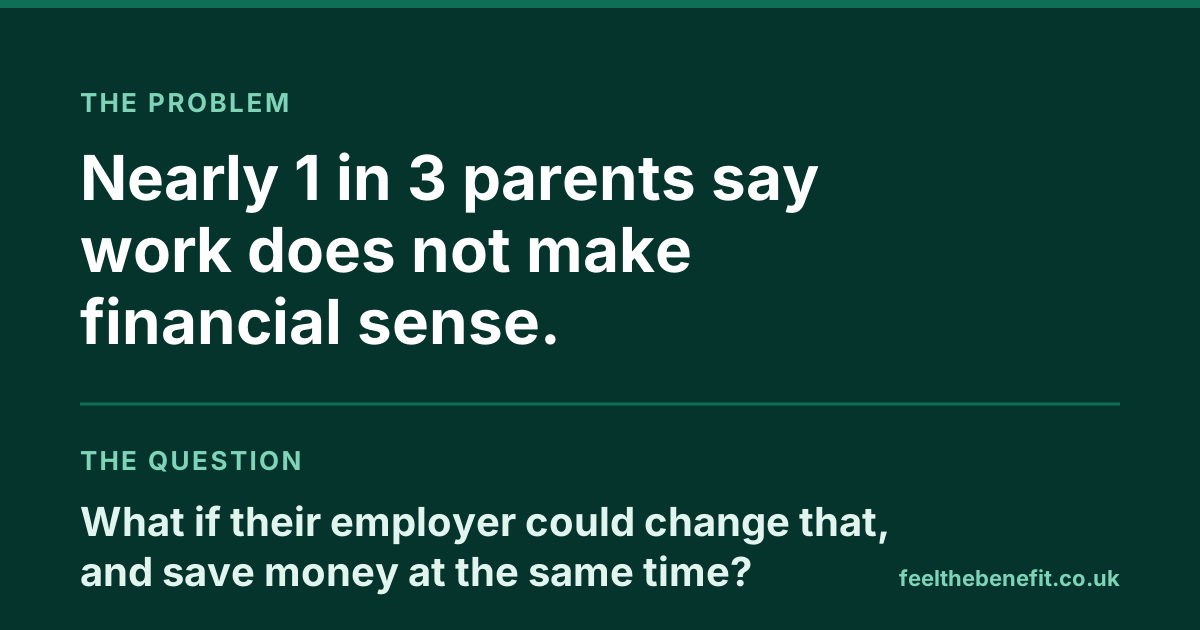
There is another way to pay nursery fees
Most employees pay their nursery from take-home pay. It does not have to work that way.
A Salary Sacrifice Nursery Fee Scheme, also known as the Workplace Nursery Scheme, allows qualifying nursery fees to be paid through an employee's gross salary, before Income Tax and National Insurance are calculated.
The employee keeps the same nursery. The care itself does not change. What changes is how it is paid for.
It is an established employer-supported arrangement based on Section 318 of the Income Tax (Earnings and Pensions) Act 2003. It has been in the statute book for more than two decades.
And unlike Tax-Free Childcare, there is no £100,000 earnings ceiling on the Workplace Nursery Scheme. For your senior women, that difference is enormous. Tax-Free Childcare is withdrawn in full the moment either parent's adjusted net income reaches £100,001, with no taper at all.
The employees with the most experience, the most responsibility and the highest replacement cost are the ones locked out of every other form of support. See a full comparison of the Workplace Nursery Scheme vs Tax-Free Childcare.
Consider one of your senior women earning £125,140
Suppose she has one child in nursery costing £1,800 a month. That is £21,600 a year. Without a Workplace Nursery Scheme, those fees come out of her take-home pay.
At that income she is also inside the £100,000 to £125,140 band where the Personal Allowance is progressively withdrawn. That creates an effective 60% Income Tax rate on part of her income. Including employee National Insurance, the marginal deduction on that slice reaches 62%.
Now put the nursery fees through salary sacrifice. With annual fees of £21,600 and a 15% management fee, the annual sacrifice is £24,840.
Same employee. Same job. Same child. Same nursery. A completely different calculation about whether working is financially worthwhile. See the full high-earner breakdown.
And here is the part employers do not expect
Salary sacrifice reduces the employee's gross salary, which reduces the employer's National Insurance bill with it.
Using the same £125,140 example:
The employer funds its contribution to the nursery out of the National Insurance saving, and is still £1,926 a year better off.
That is why we think the Workplace Nursery Scheme should be viewed differently from most employee benefits. It is not another expense for HR to justify. It makes a nursery place dramatically more affordable for an employee while reducing employment costs for the business at the same time.
Model the numbers for your workforce with the employer calculator.
Now compare saving £1,926 with the cost of a replacement.
Recruitment fees. Management time. A vacant role. Lost productivity. Training. Onboarding. Customer relationships. Institutional knowledge. Months before a replacement reaches the same level of effectiveness.
We are not going to put a figure on that, because you already have one. Anyone who has replaced a senior person knows roughly what it costs, and knows that the invoice from the recruiter is the smallest part of it.
The rest never appears in a budget line, which is exactly why it goes unmanaged.
And perhaps the hardest cost of all to measure: the women elsewhere in your organisation who see what happened, and quietly draw their own conclusions about whether this is somewhere they can build both a career and a family.
A nursery benefit belongs in a different conversation
That is why a nursery benefit should not only be discussed as a family-friendly perk.
For employers with substantial numbers of women in their workforce, it belongs in the conversations about:
- Retention — keeping experienced people through the nursery years
- Progression — removing the financial pressure that flattens careers
- Recruitment — what your offer signals to candidates with families
- The gender pay gap — reducing the years out that widen it
- Workforce planning — accounting for the real cost of attrition
Do not wait until somebody announces a pregnancy
There is another reason to talk about this benefit openly. Its value begins before anybody uses it.
A woman considering joining your organisation is already wondering what having a family there would look like. An employee in her twenties or thirties is looking at the careers of the women above her. A mother preparing to return from maternity leave is certainly doing the financial calculation.
Seeing that her employer offers a meaningful nursery benefit sends a very different message from discovering it after she has already decided that returning does not add up.
It says: you do not have to choose between building your career here and paying for nursery.
The question for employers
You know what you spend on recruitment. You know what you spend on salaries. You probably know your annual turnover rate.
But do you know how many experienced women leave your organisation in the years immediately after having children?
And have you ever calculated what preventing one of those departures would be worth?
Because there is a strange feature of the Workplace Nursery Scheme. The employee can save thousands. The employer can save money too. The nursery receives additional employer support.
Yet many organisations still do not offer it, simply because nobody has told them it exists.
That is something we think is worth changing.
See what the numbers look like for your workforce
Feel The Benefit provides a fully managed Salary Sacrifice Nursery Fee Scheme for UK employers. We coordinate the employee, the employer and the participating nursery, manage the documentation and administration, and give employers a straightforward way to offer the benefit without creating another HR project.
If you want to see the numbers before speaking to us, start with a calculator.
Sometimes the most valuable employee benefit is not the one that costs the employer the most. It is the one that gives somebody a reason to stay.
Common questions from our FAQs
Statistics in this article are reproduced with permission from Fertifa and originate from Pregnant Then Screwed, the LEIA UK Report 2026, NCT's From Expectation to Reality, Scottish Widows' Women and Retirement Report 2025 and Fawcett's The Ethnicity Motherhood Pay Penalty. The broken rung quotation is from Kweilin Ellingrud, Lareina Yee and María del Mar Martínez, Harvard Business Review Press, 2025. Our thanks to the team at Fertifa.
Calculations use 2026/27 England tax and National Insurance rates: Personal Allowance £12,570 tapered by £1 for every £2 above £100,000, basic rate band £37,700, employee NI at 8% and 2%, employer NI at 15% above £5,000, 15% scheme management fee. Scottish tax rates differ. Salary sacrifice reduces contractual gross salary and can affect salary-related benefits and statutory payments. Individual circumstances should always be considered before entering an arrangement.
We're here to help
If you have any questions at any point, our friendly team is always happy to assist.
Get in touch
Our team is ready to answer any questions you may have.